
The Human Auditorium
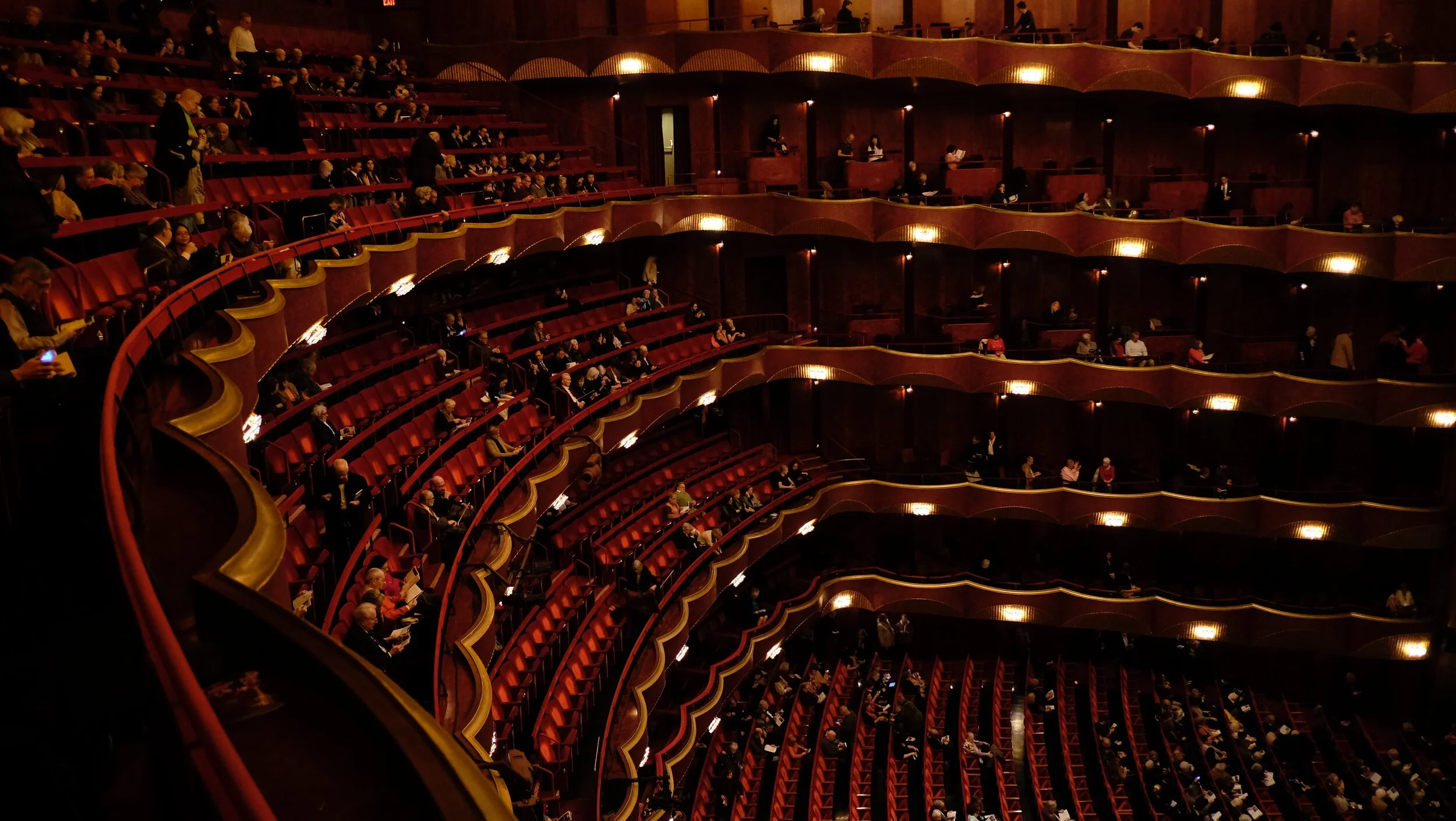
One of my most memorable theater experiences was taking one of my boys to see Harry Potter and The Cursed Child, a Broadway show based on J.K. Rowling’s famous book series. My wife, who is bewilderingly lucky, won the ticket lottery again and got me and my son two seats—first row, house right. We felt like kings.
As it turns out, front row seats aren’t always what they are cracked up to be. When we sat down, we could tell right away that our view was going to be obstructed by the height of the stage. As the show went on, we realized we were sitting at such a sharp angle that we couldn’t see what was going on at the back of the stage. Evidently, that’s why these seats were up for the lottery.
But then we saw the stage effects. In an age where many are accustomed to digital CGI, seeing the practical mechanics involved in staging dazzling visual effects for a live audience was magical. From our angle, we were able to steal a fleeting glance at how some of the tricks were done. Far from disenchanting the story, it somehow added to the wonder for me. It felt like we had snuck our way into the inner ring of stage magicians. Everyone in the audience saw the same play that night; but we felt like our cheap-seat tickets gave us a view that no one else did. Kings, indeed.
The Human Auditorium
The late missiologist Andrew Walls offered a scenario not unlike this to help us think about contextualization in gospel ministry. He asks us to imagine an enormous theater in which every seat has been carefully designed by its architect to have a partially obstructed view of the stage. On the stage is the unfolding drama of human history—the life of this world. It is an incredibly rich, complex, multi-act play. Walls describes the theater this way:
It is a crowded theatre, with a huge stage, and a stream of actors passing across it. Everyone in the packed auditorium can see the stage, but no one sees the whole of it. People seated in one place cannot see the entrances left, though they can hear the actor's voice as he enters from the wings. Seated somewhere else, the view is obstructed by a pillar, or an overhanging balcony… As a result, though everyone in the audience sees the same play and hears the same words, they have different views of the conjunction of word and action, according to their seat in the theatre… But it is a condition of being in the audience that what we see most clearly is governed by where we are sitting in the theatre.
The play we are watching is the drama of life… Now this drama has a development which is vital to the plot, which we may call the Jesus Act. For this act the conditions are the same as for all the others; everyone sees the stage, but no one sees the whole stage. People in the auditorium view of the Jesus Act on the part of the stage most open to them where they are sitting.
For Walls, “the human auditorium” (as he called it) was a way of situating crucial concepts involved in the complex task of contextualization. To consider some of these concepts, let’s go on a “guided tour” of this unusual theater—even taking a peek behind the curtains.
The Shared Stage
The stage of our theater is the shared place and time of the drama of human history. Crucial to the biblical faith, this public stage is the same stage upon which God has decisively acted to redeem all of human history through the incarnation, death, and resurrection of his Son, Jesus Christ. The acts performed on this stage are real actions performed by real actors who exist outside of the minds of the audience. This theater is not a collection of private viewing booths where audience members select and narrate their own stories according to their preferences. Everyone sees the same play performed on the same stage. There is an inescapably objective and universal quality to the truth of the drama unfolding on this stage.
Yet, to be on the stage of objective, historical truth is also to be subjected to the limits of the auditorium itself. Walls explains it this way:
This limitation [of audience members able to see some, but not all, of the stage] is a necessary feature of our hearing the Gospel at all. For the Gospel is not a voice from heaven separate from the rest of reality; it is not an alternative or supplementary programme to the drama of life which we are watching. The Jesus Act, the Gospel, is in the play. That is the implication of the Incarnation…
It has to be received, therefore, under the same conditions as we receive other communication, through the medium of the same faculties and capacities. We hear and respond to the Gospel, we read and listen to Scriptures [in the same way we hear and respond to all of the rest of life:] in terms of our accumulated experience and perceptions of the world… Responsive hearers of the Gospel respond in terms of their own lives...
That final line bears some further reflection. Walls is saying that those who hear the Gospel and respond in faith do so because they have heard the Gospel as a relevant and fulfilling part of their own story—they have come to see that the Jesus Act is in the play, the decisive fulfillment of the drama of the whole human story as they have seen it. On the other hand, those who hear the Gospel but do not respond in faith may have seen the Jesus Act, but see it as part of a story other than their own—a story playing in another theater, as it were. Hearers who respond to the gospel do so “in terms of their own lives.” So, the Jesus Act being on this stage asserts both its objective character as public history and its universal character as the ultimate fulfillment of every culture’s desire for a meaningful existence.
The Obstructed Seats
Now we step off the stage and make our way through the aisles to find our seat in the theater. For Walls, this seat represents our particular socio-cultural location, the perspective from which we view the entire drama on the stage. He explains it this way:
Our seat in the theatre is determined by a complex of conditions: where we were born, where our parents come from, what language we speak at home, what our childhood was like, and so on. People who share broadly similar conditions form culture blocks—rather like blocks of seats in the theatre, from which the view of the stage is very similar. Culture is simply a name for a location in the auditorium where the drama of life is in progress…

When we settle into our seat, our attention is naturally drawn to what we can see from it. It seems to us that our seats are quite good. And perhaps we only become aware that our view may be obstructed when we overhear others talk in passing about what they see on the stage. Our social location gives us both unique sightlines into the drama, while obscuring other aspects of it from our view at the same time.
It is worth noting that as you look around, it is clear that the seats were intentionally designed this way. These obstructed views aren’t the result of a flawed design, much less the remains of a disastrous fall. That is to say, the limits of our knowledge portrayed here are part of God’s gracious design. Omniscience was always meant to be an incommunicable attribute of God—a characteristic unique to God alone.
This means a tragic mistake we could make in understanding God’s redemption is not acknowledging that we don’t know everything. To believe that what we see from our seat is the definitive understanding of the drama would not only be full of hubris; it would be idolatrous. It is, in fact, the same idolatry that reaches back to the Garden of Eden, where the first temptation was the desire to know as only God can know. The obstructed seats of this theater represent to us the reality that while we image-bearers can know truly, we cannot know exhaustively. Objective, universal truth is available to us—particularly as narrated to us by God in his Word—but we can only begin to make sense of it using what is available to us within our own personal, situated, limited location. We were made in part to see from our particular seat.
The Dinner Table
We have a shared stage where the acts of God in history are inescapably objective and universal. We also have the limits of our true, yet obstructed, views from our situated seats. As the final part of this tour, imagine we’ve seen various acts of this unfolding divine drama. Once the house lights turn on, we gather with friends in the lobby and go out to dinner together. We all excitedly talk about what we just saw around the dinner table.
Walls himself sees this table fellowship as a crucial component of his human auditorium metaphor. In asking whether it is possible to understand the drama of God’s redemption in a way that could critique our own cultural perspectives, he writes:
Of course, it is possible to get up and change one's seat; but while this may provide a different view of the stage, it will not enable a view of the whole stage at once; and the way a person who changes seats understands the performance as a whole will still be affected by where they were sitting for the first act. Certainly, some people will see more than others. Those who lean forward eagerly, those who crane round the obstructive pillar, will see more than those who loll back in their seats. [But those] who get up at the interval and compare notes with friends sitting elsewhere in the auditorium will perhaps understand the action best of all.
It is around the dinner table, each sharing what we saw of the beauty of redemption in Christ, that we begin to realize that we were wondrously made to need each other—not just as a matter of ethics (how we should behave), but as a matter of epistemology (how we can truly know). It is over the breaking of bread that we listen to others—those gloriously different from us—and hear wondrous aspects of God’s multi-faceted redemption in Christ we had simply missed. We, in turn, offer others the riches we uniquely perceived from our seats—riches entrusted to us by God to share with others. Through the joy of fellowship, we find our understandings sharpened and expanded in ways we could never have imagined.
If we are to worship God for the fullness of who he is and all he has done in Christ, the cross-cultural fellowship of the people of God is not a “nice to have” ethical imperative. It is a “need to have” epistemological imperative. When we fail to do the work of contextualizing the gospel into the culture of every tribe, nation, and tongue, we impoverish ourselves and rob the Triune God of the glory he deserves for his matchless beauty and grace. To paraphrase Walls from another essay, cultural translation of the gospel does not negate the tradition; it enhances, enriches, and enlarges it.
Epilogue: The Cheap Seats
Return with me for just one more moment to the cheap seats my son and I enjoyed that night on Broadway. When we consider the inverted nature of the Kingdom of God—where the way up is the way down, where the way to save your life is to lose it, where the way to true wealth is to give it away, where the way to true power is through weakness, where the way to true blessing is to learn to be poor and meek—it is not a reach to say that there’s something important about the view from the cheap seats.
What the story of Jesus shows us is that, in the economy of the Kingdom, the best seats in the house are not going to be those sold for the highest price to the powerful, wealthy, and privileged. No, the Kingdom’s best seats may be the ones no one else wants, that have to be given away freely by grace alone. For those of us in the Western world, are we intentionally listening to voices from the global church and the margins of our own society—and expecting to hear something that enriches our understanding of the gospel? Are our churches moving toward relationships with those in our neighborhood who sit in different “seats”? It may be that our sisters and brothers in these seats have unexpected insight into the backstage workings of the Kingdom of God, insights that are hidden from our own view. Then, we begin to see a fuller picture of the wonder of God’s Kingdom. Kings, indeed.

About the Author
Abraham Cho is City to City North America’s Director of Training. With 15 years of experience in urban ministry, history with Redeemer Presbyterian Church in NYC, and leadership within the Asian American community, Abe seeks to advance the church's mission in North America.
He and his wife, Jordyn, have four children—Lydia, Ezra, Micah, and Judah.