
Remembering My Master
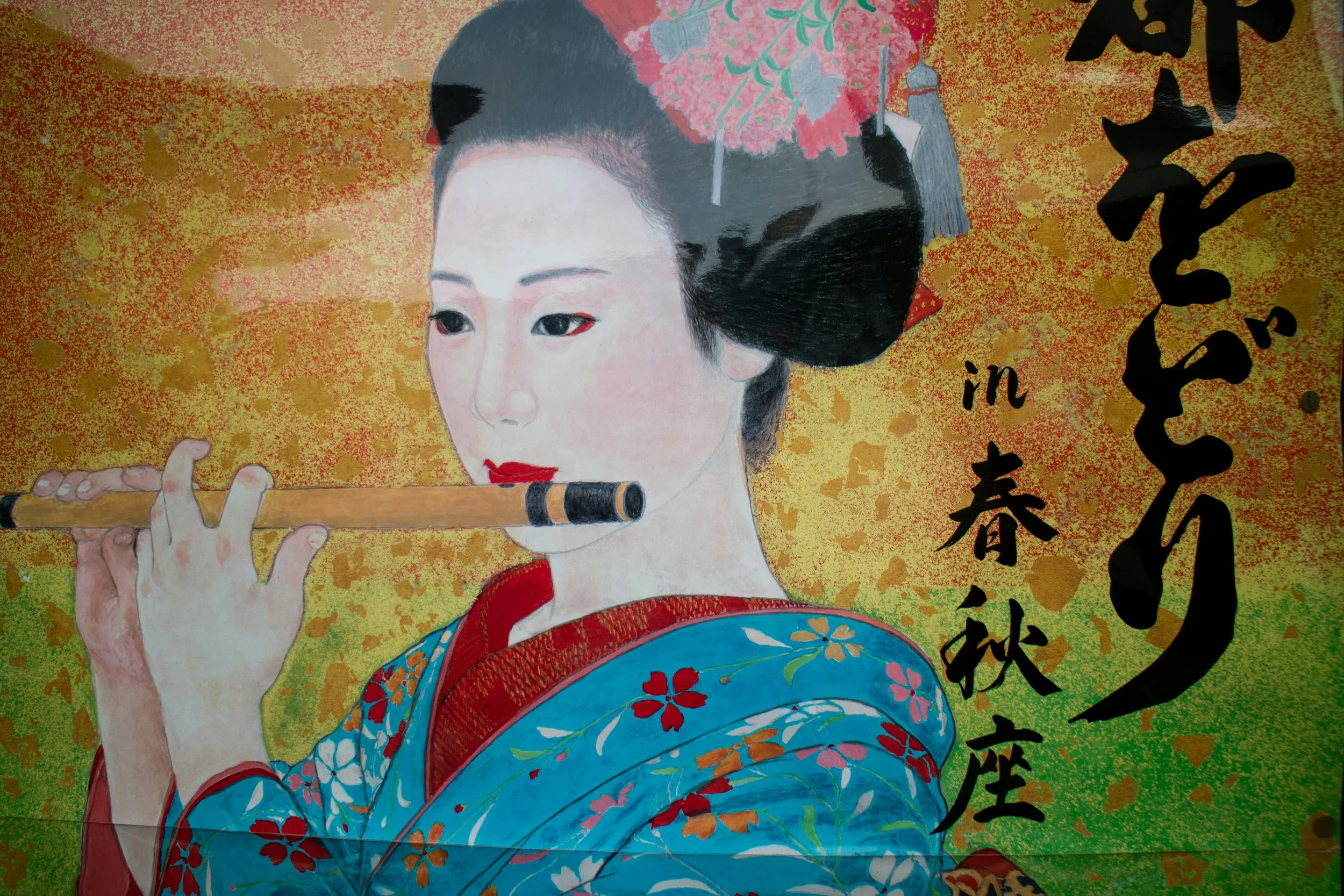
I remember when I heard the news that my teacher passed away.
I took Japanese dancing lessons from this teacher for several years in the past. It was an original style that she came up with and called “praise dancing.” She was free and creative in her ideas—and I learned so much from her.
Before World War II, she grew up walking from her home in downtown Tokyo’s doll merchant district to an elementary school affiliated with national University in an upscale neighborhood. She also grew accustomed to both kabuki and rakugo (comedic storytelling), two Japanese performing arts which were respectively highbrow and less classy at the time. Her aunt, a master in the hanayagi style of dancing, gave her lessons from an early age at one of the most well-known classical dance schools in the country.
Her experience with different environments and people of multiple walks of life gave her an ability to adapt well and be flexible. Because she was tall, she was often given the role of male characters over the other women in her class, and she could definitely embody their dashing nature. Whenever she instructed me how to dance like a man, she would thrust out her arms dramatically from her kimono sleeves and shout in a classic Tokyo man’s accent, “Look, this is how you do it!” But she almost always maintained a pleasant demeanor. Even when I messed up by being late for class or otherwise, she would smile and say calmly, “It’s okay.”

My daughter, around the time she was in first grade, happened to see a group of missionaries’ children participating in a dance lesson at church once. She begged me to let her join the lessons, too. I did. And one day after her lesson, I was asked by the teacher if I was interested in taking lessons, as well. Before long, I was one of her students. In the world of Japanese performing arts, the sooner you start your training, the better. Yet here I was! I was amused when my teacher told me to call my daughter “elder sister” because she had, of course, been in the class longer than I had. This teacher also told me to call her my “master.” To her, the “teacher” was pastor of her church, not her.
As I got to know her, my master told me she first experienced faith in Jesus in her 40s, but scarcely gave other details. She said she wanted to perform Japanese dancing set to the music of Western hymns—an unusual practice considering the hymns have a vastly different tonal and rhythmic system than the Japanese music that traditionally accompanies such dances. And so, she traveled to the headquarters of the dancing association to ask permission to do this. There was certainly no indication that the association would respond favorably to this; she was so committed to this vision that she was willing to be expelled and have her title revoked. To her, praise dancing for Christ was the natural way to combine her skills, experience, and faith. The fact that she was willing to give up the title she had spent so long working toward reminded me of Paul’s faith in Philippians 3:7-9:
7 But whatever gain I had, I counted as loss for the sake of Christ. 8 Indeed, I count everything as loss because of the surpassing worth of knowing Christ Jesus my Lord. For his sake I have suffered the loss of all things and count them as rubbish, in order that I may gain Christ 9 and be found in him, not having a righteousness of my own that comes from the law, but that which comes through faith in Christ, the righteousness from God that depends on faith…
One time, she taught me a move in which the dancer takes one step forward, points an index finger backwards, and looks back. She explained, “When you turn back and see your pointing finger, you are looking at your whole life in the past.” When I heard this, I couldn’t help but cry. She calmly told me that since before I could remember, God has always been working in every area of my life and protecting me with His love. It was an overwhelming experience of God’s grace—so overwhelming that I didn’t even fully grasp what she was telling me. I was so full of emotion I could barely stand, but I also felt like I was held securely as if I was right in God’s arms. My master may not have known, but she was exactly the type of person that could teach such a lesson.
On another occasion at a church celebration event, she showed up onstage in a kimono with a camellia pattern on vermilion silk and a black sash. She spread her arms, raised her head, and turned around. We could clearly see the image of Christ on the cross even though there was no backdrop, props, or lights. She was reflecting, as she had taught me, the connection between the lyrics and performance, even down to the pattern of the costume.

My master often told me that I should become a choreographer. She noticed that I never felt as natural at dancing as my daughter did; this was my master’s way of encouraging me despite my lack of talent. As my kids grew up and became busier, my master’s health declined, and my lessons eventually stopped. In the past, traditional dance recitals were held in large concert halls, but no one performs them there today.
My teacher became a Christian midway through her life. She remained faithful to her home church from its beginning as a plant to its growth into a full-fledged congregation, sharing the gospel through dance all the while. Her work was a wonderful example of contextualizing the gospel for the Japanese in her time and place.
Now, as I reflect on her work, I am urged to find my own way to contextualize and express the gospel in my own context. Yet, I also feel at ease knowing I’ve been accepted already. I sense our greater Master saying, “It’s okay,” in response to my shortcomings; He has already gone to the cross for me. As my master showed me, there are freer and richer ways to express and contextualize the gospel than we might expect. I wish to show others freedom in Christ just as she showed me—and to talk with her about it once I see her in heaven again.

About the Author
Asako Hirohashi is the Director of Translation and Content Creation for City to City Japan. After graduating from International Christian University, she translated books including The Prodigal God, Counterfeit Gods, and The Meaning of Marriage. Her husband Shin is a pastor, and together they functioned as the Center Church translation project’s manager and translator.